 Magyar
 English
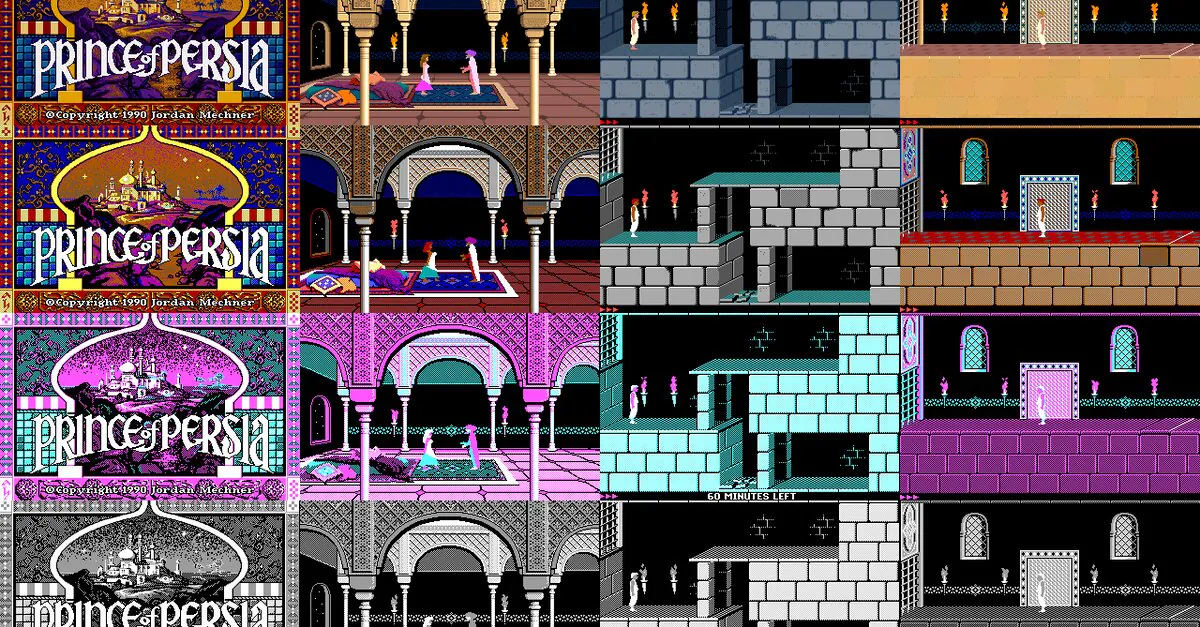
Once upon a time, in the early ’80s, IBM’s basic PCs (XT, AT) didn’t offer many colours to play with. They were primarily business machines. Everything else, games included, played only a secondary role, even if many games were ported to the PC. Compared with the Commodore 64 or the Apple II line (which was a real rarity in our part of the world), IBM’s machines were visually rather dull.
Although many display standards appeared between the early ’80s and the ’90s, three major standards became popular among games written for the IBM PC and compatible computers.
The first graphics adapter that brought at least a little life to the screen was the Color Graphics Adapter (CGA): it is considered IBM’s first graphics card, and in 1981 it also set the standard for the IBM PC line. It was a step forward from the MDA, IBM’s Monochrome Display Adapter, which could only show green text on a black background. Do the monitors in Fallout 3 and New Vegas look familiar? In that universe, the MDA obviously never died out.
CGA cards had 16 kB of graphics memory, could be connected to a monitor (at the time, the type of monitor – RGB or composite – also had a big effect on picture quality) or a television, and in theory could display up to 16 different colours. Their maximum resolution was 640×200. Compared with the competition they weren’t pretty, but they did the job. In 320×200 mode, only 4 colours could be shown at a time. In 640×200 mode this dropped to 2 colours.
Surprisingly, CGA also had a competitor in Hercules Computer Technology with its Hercules Graphics Card. It was cheaper than IBM’s CGA cards and was compatible not with CGA but with IBM’s monochrome MDA standard: it added a high-resolution (720×348 pixel) monochrome graphics mode to the MDA’s sharp text display, but it couldn’t display colours. In the business world, however, that didn’t matter much, so the card became extremely popular.
CGA was followed in 1984 by EGA, the Enhanced Graphics Adapter. It could display 16 colours at a time out of 64 available, and raised the maximum resolution to 640×350. It also improved the CGA modes: it could display 16 colours at a time in those too, although the transition wasn’t always smooth. It also had 64 kB of graphics memory.
EGA didn’t last long either: in 1987 IBM itself pushed it out with the arrival of VGA. VGA, the Video Graphics Array, appeared together with IBM’s PS/2 computers and brought a number of key innovations, such as the famous 640×480 resolution and the 15-pin VGA monitor connector, which – depending on where you look – many people still use today.
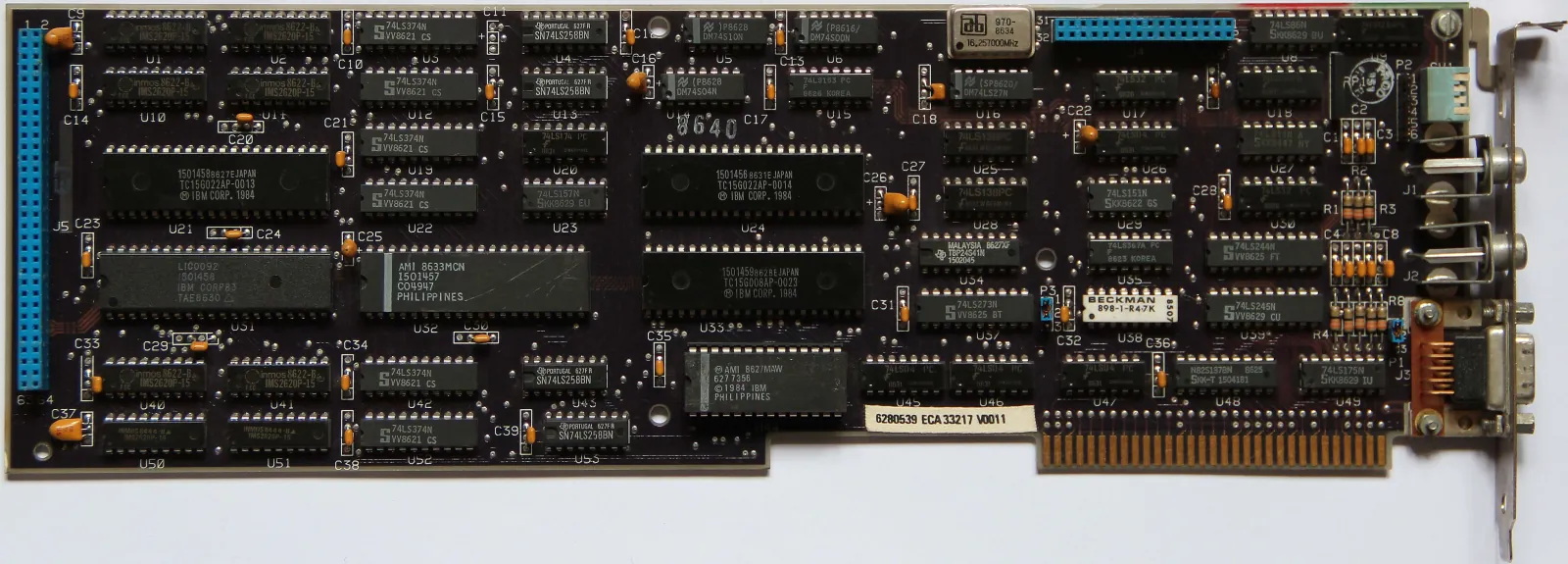
VGA was one of the factors that helped IBM PC clones quickly gain ground in the games market at the expense of consoles and home computers, and visually they eventually overtook platforms such as the Commodore 64, the Amiga and the ageing Apple II line, especially once third-party manufacturers jumped on the bandwagon with their own adapters, from Hercules to Diamond.
So what made it so good? CGA and EGA cards were built from several chips, but VGA needed only one, which could even be integrated into the motherboard. The VGA palette also had 262,144 colours, a huge leap from EGA’s 64-colour palette. From this palette it could display 256 colours at a time at 320×200, and 16 colours at a time at 640×480. The 640×480 resolution not only became the high-end standard for games, but in the 2000s it also became a popular resolution on mobile devices such as Pocket PCs.
The VGA standard also got a number of enhancements, such as “Super” VGA, which built on IBM’s VGA standard. SVGA added several innovations to VGA, such as 800×600 resolution at 4-bit colour depth, later extended to 1024×768 at 8-bit colour depth.
In 1990 the XGA standard also appeared, which IBM tried to introduce as the official successor to VGA, and which raised the resolution to 1024×768 with 256 colours. In the end, however, it was overshadowed by the popularity of SVGA, as third-party and clone manufacturers pushed SVGA hard, and end users were confused about whether they needed to replace their RGB monitors with SVGA-compatible ones.
From the early ’90s, VGA and its derivatives became the de facto baseline standard for anyone who wanted their games to look good, especially when games such as Origin’s Wing Commander showed what it could do. Although you could also play it in EGA or MCGA mode (think of MCGA as a lower-resolution version of VGA), people were amazed at how the game looked in high-resolution VGA. So were we.
As many IBM PC clones with impressive graphics and sound appeared in those years, these machines fought their way to the top, to where a few of their rivals had dominated the games market in the ’80s. The business giant had finally joined the party. From the early to the late ’90s, there were few game developers who didn’t want to boast VGA or SVGA support, which started a real hardware arms race, especially as the development of 3D games accelerated.
By the mid-to-late ’90s, with the rise of 3D graphics technology, labels such as “VGA-compatible” on PC game requirement lists gave way to new standards such as Microsoft DirectX, Windows, Linux, MacOS and Pentium. These were arguably easier standards to deal with for developers and gamers alike, who no longer had to worry about whether their monitor was SVGA-compatible or not.