 Magyar
 English
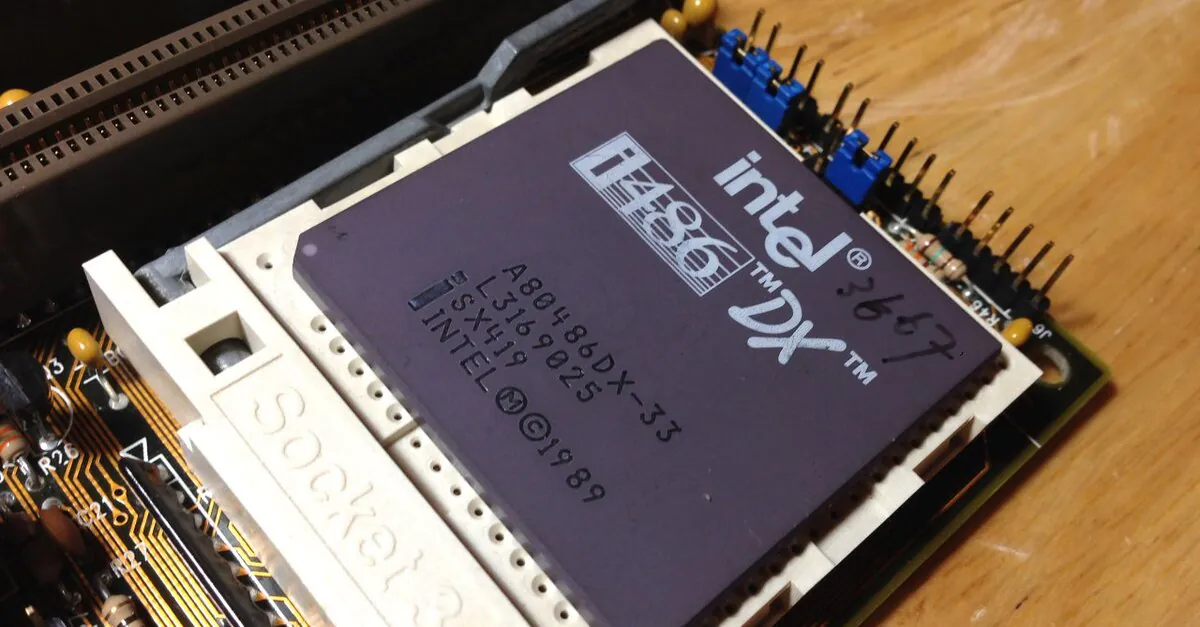
A few weeks ago (in October 2022), Linus Torvalds suggested on the Linux kernel mailing list that it might be time to drop support for the Intel 80486 architecture. Giving up an old and little-used architecture is no surprise: a decade ago the same fate befell Linux’s first platform, the 80386. The 486 line may be long dead on the desktop, but since it hasn’t completely disappeared from the world of embedded systems and is still a favourite of retro computing, it’s worth taking a minute to look at what consequences this step might have, if any.
The suggestion has since become reality. In April 2025, Ingo Molnar submitted a proposal to remove support for processors without the TSC and CX8 (CMPXCHG8B) instructions. Its first step, the “x86/cpu: Remove M486/M486SX/ELAN support” commit, was merged into the x86 development branch in March 2026. The change arrived in the Linux 7.1 kernel, released on 14 June 2026: the M486, M486SX and MELAN options, which allowed building for 486 and AMD Elan processors, are gone, and the minimum processor family of the 32-bit x86 kernel has been raised from the 486 (4) to the Pentium class (5). The Linux 7.1 source also states that 386 and 486 processors are not supported. Owners of 486 machines can therefore only use kernel 7.0 or older.
Does the 486 even exist any more?
The Intel 80486 was released in 1989 and was a substantially improved version of the earlier 80386 32-bit microprocessors, with on-chip cache, more efficient pipelining and a built-in maths coprocessor. It had a 32-bit address space, although in practice, because of the RAM and motherboard limitations of the 1990s, a typical 486 system had only a few megabytes of memory. Over its lifetime there were several versions with clock speeds from 16 MHz to 100 MHz, as well as an entry-level “SX” version with the coprocessor disabled. As a processor capable of running Windows 3.1 it was an object of desire for many, and it remained an adequate platform for Windows 95 too, but by the end of the ’90s the performance of the 486 was no longer enough on the desktop. Intel continued the product family as an embedded processor in the 2000s, until it finally discontinued it in 2007. The story of the 486 was far from over, however, because during its active life many competitors made their own versions. The non-Intel 486 chips outlived the original, and even today, in 2022, several companies still manufacture 486-compatible devices. RDC makes RISC SoCs that run 486 code, and according to the ZF Micro Solutions website, they still boast an SoC descended from the Cyrix 486 series.
How much longer will it be with us?
In 2022, few engineers would probably choose these parts for a new x86 embedded design, not least because the market offers a much wider choice of devices with Pentium or newer cores. We have come across them in modules used in industrial applications, and we assume they are still in production because somewhere there are still long-lived machine product lines that use them. We fell rather in love with the RDC part, a complete 486 PC on a single chip that draws only 1 W: our ’90s selves would have drooled at the thought of a handheld 486 PC with long battery life. Here in 2022, though, if we wanted a portable 486 gaming experience, there are plenty of ARM-based boards that run a software emulator fast enough that we wouldn’t notice the difference. So will the relatively small community of 486 users miss support for their platform in newer Linux kernels? To answer that question, it’s worth thinking about what software these machines are likely to run.
If there is one thing operators of industrial machines value, it’s consistency. For them, the machine is more an appliance than a computer, and it has to do its job continuously and flawlessly. For that it needs a rock-solid, stable software base, not one that changes by the minute. So does an outdated industrial controller need the latest Linux distribution? We think probably not; in fact, we suspect an outdated x86-based industrial controller is much more likely to be running a version of DOS. Meanwhile, the retro computing crowd also tends to run a version of DOS or Windows, so it’s hard to imagine many of them trying to squeeze the latest system into a 486DX with 16 megabytes of memory.